

We explore commercial sex as enmeshed in power relationships and economies of desire that are inherent within all sexualities.
Contemporary gender and sexuality studies have much to offer the study of sex work which involves men, women and transgenders as buyer and sellers of sexual services.
Recent work on the production of sexual subjectivities under neoliberalism highlights the potential of a political economy approach to sex work – one that goes beyond debates about coercion and choice to understand better the structures of constraint and scenarios of agency within which sex is bought, sold and traded.
- Diversity of commercial sex among men and male-born trans people in three Peruvian cities – 2011
An article in Culture, Health & Sexuality: An International Journal for Research, Intervention and Care, Volume 13, Issue 10.
In Peru, commercial sex involving men and male-born travestis, transgenders and transsexuals (CSMT) is usually represented as a dangerous practice carried out on the streets by people experiencing economic hardship and social exclusion. However, in reality little is known about the complexities of this practice in Peru.
- Draft of new Global Declaration on the Rights of Sex Workers – 2011
The following is a draft declaration on sex workers rights and introductory article. Thank you very much to those who made inputs.
The process used to develop this was to copy the ICRSE declaration format and cut and paste material from all documents together into the sections then edit them down to about 20% of the length. This means that the document attached comprises sentences and bits of sentences from various documents by sex workers and allies.
- Feminism, power and sex work in the context of HIV/AIDS: Consequences for women’s health – 2011
Article in the Harvard Journal of Law and Gender, Vol 34, p225 – 258.
- Gay community, sex workers, health care providers, the police and legal representatives join in to mark IDAHO – 2011

Kenyans, drawn from the gay and lesbian community, male and female sex workers, representatives of the police force, health care providers and also legal professionals came together to mark the International Day Against Homophobia and Transphobia (IDAHO)in Kisumu, Kenya.
- HIV and Sex Work in Cambodia – 2011
Cambodia is internationally recognized for having successfully reduced its HIV prevalence among the general population from about 3% in 1997 to 0.7% in 2009. Sex work played a significant role in the spread of the HIV epidemic during the nineties. Since 1999, HIV prevalence has declined among direct and indirect sex workers, although levels remain high. The 100% condom use promotion strategy has been credited for having played a major role in the decline of HIV.
- HIV-related risk behaviors among kathoey (male-to-female transgender) sex workers in Bangkok, Thailand. – 2011
Based on combined methods, this study investigated substance use and HIV risk behaviors among kathoey sex workers (KSWs) in Bangkok, Thailand. The study found that only half of the KSW participants reported having been tested for HIV, and that except for one participant, all others had not seen health care providers in the past 12 months. About one third of the participants reported having engaged in unprotected anal sex with customers in the past six months.
- Indigenous Peoples In the Sex Trade – Speaking For Ourselves – 2011
By the Native Youth Sexual Health Network on Thursday, June 9, 2011.
We as Indigenous peoples who have current and/or former life experience in the sex trade and sex industries met on unceeded Coast Salish Territory in Vancouver on Monday April 11th 2011. In a talking circle organized by the Native Youth Sexual Health Network we wish to share the following points about our collective discussion so that we may speak FOR ourselves and life experiences:
- Loverboys in the Amsterdam Red Light District: A realist approach to the study of a moral panic – 2011
An article in Crime Media Culture August 2011 vol. 7 no. 2 185-199.
- Men and Development: Politicizing Masculinities – 2011
‘Men and Development: Politicizing Masculinities’ includes a chapter entitled ‘The Good, The Bad and The Ugly: Constructions of Masculinity and Contemporary Understandings of Sex Work’ that looks at men as buyers and sellers of sex and desconstructs the myth of the ‘pimp’.
- MSM sex-workers in Hanoi: High risk behaviors and barriers to HIV prevention – 2011
This is a study of 150 MSM sex workers who were interviewed by quantitative questionnaires, 24 in-depth interviews with 8 MSM sex workers, 3 clients of MSM sex workers, 6 doctors of VCT/STIs services and 4
with EEs with MSM sex work and 3 MSM peer educators.It concludes that
- Sex Workers’ Rights in Kenya: “It’s Better to Be a Thief Than Gay in Kenya” – 2008
A news story from the Toward Freedom website.
- Realising Sexual Rights – 2007
A meeting report from the IDS Sexuality and Development Programme.
- Why the Development Industry Should Get Over its Obsession with Bad Sex and Start to Think About Pleasure – 2007
An IDS working paper by Susan Jolly.
- Surplus men, sex work, and the spread of HIV in China – 2005
..the future of the [HIV] epidemic depends on the magnitude of HIV spread in India andChina, the world’s most populous countries. China’s 1.3 billion people are in the midst of significant social transformation, which will impact future sexual disease transmission.
- Work, sex, and sex-work: Competing feminist discourses on the international sex trade – 2004 An article in the Osgoode Hall Law Journal, Vol 42, No 1. The focus is on analysing the competing discourses of radical feminism and sex radicalism.
- El Trabajo Sexual : La indústria del sexo en contexto – 2003
Spanish version of 2003 book ‘Understanding Sex Work’ by Cheryl Overs.
- HIV/AIDS, gender and sex work – 2003
This short fact sheet outlines the key issues and HIV risks associated with sex work in many parts of the world including: high rates of STIs and HIV; poverty; low educational level; limited access to healthcare services and prevention commodities; gender inequalities; social stigma and low social status; drug or substance use and; a lack of protective legislation and policies. It suggests that the following types of HIV programmes have been successful in meeting sex workers’ needs:
- Who gets to choose? Coercion, consent and the UN – 2002
- Eliminating Violence Against Sex Workers
In their work and lives, sex workers experience disproportionate levels of violence including police abuse, sexual assault, rape, harassment, extortion, and abuse from clients, agents (pimps), sex establishment owners, intimate partners, local residents, and public authorities. Violence against sex workers is a violation of their human rights, and increases sex workers’ vulnerability to HIV. Violence against sex workers must be understood beyond the individual incidents and in a wider context of gender and stigma.
(extract from paper)
- Sex Work Matters
- HIV Gel Called Poor Substitute for Women’s Rights – 2010
VIENNA, Austria (WOMENSENEWS)–The preventive benefits of an HIV vaginal gel dominated the headlines of the International AIDS Conference in Vienna last week, but failed to allay the concerns that Mabel Bianco has about the public-health response to the epidemic.
- Institutional Responses to Sex Trafficking in Armenia, Bosnia, and India – 2010
In Hollow Bodies, Susan Dewey travels to Armenia, Bosnia-Herzegovina, and India to follow the trade in women’s bodies and efforts to stop it. What she finds is a counter-trafficking system at the mercy of funds from misguided international organizations and foreign governments. From counterproductive restrictions placed on NGOs by donors, to jaded employees and bribes given to prosecutors, Dewey highlights the structural flaws in place that allow, and sometimes even help, sex trafficking to continue.
- Issues Concerning the Informality and Outdoor Sex Work – 2010 Article in the Archive of Sexual Behaviour.
- Poll reveals details of Bogota’s prostitution business – 2010
A news story by Daniel Brody in the Columbia Reports. The story outlines the findings of an opinion survey of sex workers and their clients in Bogota which was taken by the Mayor’s Office. There is no link to the original source so we cannot comment on the accuracy of the reporting or the methods used.
- Stigma and sex work from the perspective of female sex workers in Hong Kong. – 2010
While the stigma surrounding sex work is both well documented and easily recognised, few studies examine stigma in this context from the perspective of the sex workers themselves. In this article we report on a study using a modified grounded theory approach to analyse a series of semi-structured interviews with 49 female sex workers in Hong Kong, in order to examine the ways in which this group experiences and negotiates the stigma which arises from their employment in the sex industry.
- The State of Sex: Tourism, Sex and Sin in the New American Heartland (Contemporary Sociological Perspectives) – 2010
The State of Sex is a study of Nevada’s brothels that situates the nation’s only legal brothel industry in the political economy of contemporary tourism. Nevada is part of the “new American heartland,” as its pastimes, people, and politics have become more central to the nation. The rise of a service and leisure economy over the past sixty years has propelled sexuality into the heart of contemporary markets. Yet, neoliberal laws in the United States promote business but limit sexual commerce.
- Wards of the state: Young sex workers’ special vulnerability to HIV and AIDS under the law – 2010
Young people of all ages have seen increased attention in HIV and AIDS discussions, yet there exists little to no policy guidance on providing rights-based universal access to HIV prevention, care, treatment and support for young people under the age of majority involved in the sex trade, especially those involved in what is legally defined as prostitution. The “Wards of the State” project begins an evaluation of current laws, policies and practices affecting young people in the sex trade’s access to rights-based services on a country to country basis.
- When I dare to be powerful – Sex Worker Oral Herstory – 2010
A Publication by Akina Mama wa Afrika (AMwA), written by Zawadi Nyong’o and edited by Christine Butegwa and Solome Nakaweesi-Kimbugwe.
AMwA has been working in partnership with sex worker activists in Uganda and other countries in East Africa. This oral history project allowed women to speak for themselves to try and better understand the politics behind sexuality, sexual rights and sex work.
The research tries to present the multiple dimensions of women’s lives,
- ‘Mobile Love Videos Make Me Feel Healthy’: Rethinking ICTs for Development – 2010
Author’s summary: Development discourse tends to limit attention to the contribution of information and communications technologies (ICTs) to economic and educational empowerment, largely ignoring other potential areas for empowerment. This paper explores interactions between people and communication technologies in relation to sexuality through the lens of a specific community and its use of mobile phones…
- Exploring HIV Risk among MSM in Kigali, Rwanda – 2009
The study was led by the National AIDS Control Commission (CNLS) of Rwanda, with technical assistance from MEASURE Evaluation. It presents findings from a behavioral surveillance study (BSS) of men who have sex with men (MSM) in Kigali carried out in 2008-2009. The aim of this study was to describe the population of MSM in Kigali and explore the nature of sexual activity between MSM.
- Ain’t I a Woman? A Global Dialogue between the Sex Workers’ Rights movement and the Stop Violence Against Women Movement – 2011
This is a resource written by Bishakha Datta and sponsored by CASAM and CREA. The report documents a meeting entitled “Ain’t I A Woman? A Global Dialogue between the Sex Workers Rights Movement and the Stop Violence against Women Movement” from 12-14 March 2009 in Bangkok, Thailand.
The report features the presentations from many great speakers including , Ruth Morgan Thomas, Anna-Louise Crago, Kaythi Win, Hua Sittipham Boonyapisomparn, Swapna Gayen and Meenakshi Kamble,Cheryl Overs and Meena Seshu
- An Exploratory Study of the Social Contexts, Practices and Risks of Men Who Sell Sex in Southern and Eastern Africa – 2011
The aim of the research presented in this report was to explore the social contexts, life experiences, vulnerabilities and sexual risks experienced by men who sell sex in Southern and Eastern Africa, with a focus on five countries; Kenya, Namibia, South Africa, Uganda and Zimbabwe. It sought to better understand differing and similar socio-cultural scenarios and personal life stories of male sex workers in these countries and to improve the representation of male sex workers in relevant regional organisations, particularly within the African Sex Workers Alliance (ASWA).
- Beyond compassion: Children of sex workers in Kolkata’s Sonagachi – 2011
Article in Childhood August 2011 vol. 18, no. 3, 333-349.
In 2005, children of sex workers from Kolkata’s Sonagachi red-light district formed their own collective, Amra Padatik (‘We are Foot Soldiers’), to work to gain dignity for their mothers and claim their own rights as children of sex workers. In this article the authors speak to Amra Padatik’s founder members to demystify the culture of fear associated with their lives — perpetuated through popular representations. This is not to underplay their acute experiences of disadvantage, but to foreground them as politically astute citizens and decision-makers in policies that concern and affect them.
- Buying the Girlfriend Experience: An Exploration of the Consumption Experiences of Male Customers of Escorts – 2011
Article in Russell W. Belk, Kent Grayson, Albert M. Muñiz, Hope Jensen Schau (ed.) Research in Consumer Behavior (Research in Consumer Behavior, Volume 13), Emerald Group Publishing Limited, pp.111-126.
This research explored the experiences of male customers of escorts who provide a sexual service known as the “girlfriend experience” or GFE.
Methodology/approach: A combination of depth interviews and netnography is used to study how men experience the GFE.
- Can rights stop the wrongs? Exploring the connections between framings of sex workers’ rights and sexual and reproductive health – 2011
There is growing interest in the ways in which legal and human rights issues related to sex work affect sex workers’ vulnerability to HIV and abuses including human trafficking and sexual exploitation. International agencies, such as UNAIDS, have called for decriminalisation of sex work because the delivery of sexual and reproductive health services is affected by criminalisation and social exclusion as experienced by sex workers.
- Commercial Sex Worker Use Among Male Chinese Rural-Urban Migrants – 2011
To explore HIV/AIDS sexual risk behaviors and specifically the use of commercial sex workers among Chinese male rural-urban migrants. Methods:
- Continued Sexual Risk Behaviour in African American and Latino Male-to-Female Transgender Adolescents Living with HIV/AIDS: A Case Study – 2011
Article in AIDS Clinic Res S1:002.
Purpose: This study examined the social and contextual factors associated with continued high risk sexual behaviors among male-to-female transgender (MTFTG) adolescents living with HIV/AIDS. The study is part of a larger qualitative study of 59 racial/ethnic minority adolescents living with HIV/AIDS.
Methods: In-depth focused interviews were conducted with five MTFTG adolescents (16-24 years) living with HIV. Content analysis was conducted to identify themes related to continued sexual risk behaviors.
- CREA research on violence against women in India, Bangladesh and Nepal – 2011
A research study on violence against lesbian women, female sex workers, and disabled women in three countries in South Asia—Bangladesh, India, and Nepal. The study investigated the hypothesis that women who are outside the mainstream of the South Asian society suffer high rates of violence and are often unable to seek and receive protection from State agencies.
- Demystifying Sex Work and Sex Workers – 2011
Wagadu, an open access online feminist journal, has released a special issue ‘Demystifying sex work and sex workers.’ With articles from activist scholars the special issue, focuses on the everyday lives of sex workers.
Susan Dewey of the University of Wyoming who edited the issue explains, “While recent years have witnessed a dramatic outpouring of feminist scholarship that situates sex work within its broader socioeconomic and political contexts cross-culturally, there remains a tendency for academic scholarship to unconsciously reinforce the social stigmatization of sex workers by depicting them solely through their income-earning activities. This burgeoning research has convincingly demonstrated that sex work is embedded in a complex social matrix that often centers upon sex workers’ perceptions of their individual choices and responsibilities…Public policy on sex work is often shown to be seriously lacking when contextualized within the broader realities of many sex workers’ everyday life experiences throughout the world. As such, contributors to this special issue offer sound ethnographic evidence that clearly demonstrates the global need for policy and legal reform with respect to sex work.”
- Different stage, different performance: the protective strategy of role play on emotional health in sex work – 2011
An article in Social Science & Medicine Volume 72, Issue 7, April 2011, Pages 1177-1184.
- The Ethnography of Prostitution: New International Perspectives – 2010
Prominent US sociologist Weitzer reviews books on sex work. he says ‘The best recent research on prostitution is ethnographic and centered outside the United States. The books under review are multi faceted, rich, novel contributions to the literature, throwing a spotlight on previously hidden worlds. Each presents a microcosm of commercial sex that is linked to macro-level structures. And each focuses on indoor prostitution, a welcome counterbalance to the voluminous literature on street prostitution.’
- A study of men who pay for sex, based on the Norwegian National Sex Surveys – 2010
[This study] estimates the prevalence, time trends and factors associated with paid sex among men. Methods: Norwegian Sex Surveys using similar questions in 1992, 1997 and 2002 were analyzed using a cohort analysis and logistic regression. The questionnaires included demographic background, and several aspects of sexual behaviour. The following questions on paid sex were included:
- Analysis of Sexual Orientation and Gender Identity Related Activities in Round 8 and 9 Proposals – 2010
This document from the Global Fund to fight AIDS, TB and Malaria (the Fund), authored by Adam Graham, analyses HIV proposals to the Fund in Rounds 8 and 9.
It focuses on men who have sex with men, sex workers and transgendered people and looks at levels of participation and representation, the evidence base and service delivery.
- Bibliography of Transgender Articles – 2010
- Brazilian national response to HIV/AIDS amongst sex workers – 2010
The specific objectives of the study were to explore and analyze consistencies and mismatches between existing official Brazilian policy guidelines and program implementation in the area of HIV/AIDS prevention and health care among female sex workers.
Data analysis and major findings discussed throughout the report are organized around five major themes as follows:
1) STD/HIV/AIDS prevention policies and programs directed at sex workers evolved in the last two decades;
- Claims to Protection: The Rise and Fall of Feminist Abolitionism in the League of Nations’ Committee on the Traffic in Women and Children, 1919–1936? – 2010
This article examines the League of Nations Advisory Committee on the Trafficking of Women and Children (CTW) to assess the impact of international feminists on the interwar anti-sex trafficking movement. It argues that women who were firmly embedded in the transnational and international women’s rights movement built a coalition on the CTW to ensure the prominence of the feminist abolitionist position of sex trafficking in the 1920s.
- Creative space workshop for Wonetha members – 2010
WONETHA held a Creative Space Workshop for its members from 26th to 28th May 2010. The purpose of the workshop was to conduct learning sessions that are tailored for the needs of WONETHA Members who are sex workers, to enable them improve themselves, their interpersonal skills, self esteem, self development, and self awareness. The learning sessions tapped into the natural gifts and talents of the members through the use of learning methods that employed music, dance drama, art, poetry and story telling.
- En la Calle: sex work in Quito – 2010
A blog by Anna Wilkins an anthropologist working in Quito.
- Falling through the cracks: contraceptive needs of female sex workers in Cambodia and Laos(,). – 2010
Condom is the only method promoted for dual protection among female sex workers (FSWs) in most Asian countries, which may be insufficient to prevent pregnancies given FSWs’ high frequency of sexual intercourse.Data were obtained from independent cross-sectional surveillance surveys conducted in Cambodia and Laos.
- From Client to Pimp: Male Violence Against Female Sex Workers – 2010
Article by Karandikar S and Próspero M in the Journal of Interpersonal Violence, Vol. 25, No. 2, 257-273 (2010). The study explores intimate partner violence (IPV) among female sex workers from the red-light area based in Mumbai, India. Using a grounded theory approach, in-depth interviews were conducted with ten sex workers to explore their experiences of IPV in the context of commercial sex work. Narratives were analyzed and themes constructed.
- Indian sect members vow to marry sex workers – 2009
A BBC news story available online about ‘wedding volunteers’ in India who believe that by marrying sex workers they will ‘save’ them and reduce the spread of HIV.
- Red Lights: The Lives of Sex Workers in Postsocialist China . – 2009
The karaoke bar has become a ubiquitous symbol of urban China that is often taken to represent evidence of globalization, corruption, and sexuality. Tiantian Zheng’s book Red Lights: The Lives of Sex Workers in Postsocialist China finally helps the karaoke bar and its occupants come alive. Zheng returned to her hometown of Dalian, a port city in northeastern China formerly governed under Japanese colonial rule, to conduct this institutional ethnography of the karaoke bar.
- The burden and determinants of HIV and sexually transmitted infections in a population-based sample of female sex workers in Goa, India – 2009 An article by in Sexually Transmitted Infections (2009) 85 (1) 50-59
- Transgender Health Handbook – 2009
This booklet provides information transgender health (including hormones, HIV and STIs, human rights and social well being).
This essential reading on the subject was developed by transgenders who have formed a new network in Asia and the Pacific.
- Understanding the context of male and transgender sex work using peer ethnography – 2009
An article by Collumbien M, Qureshi AA, Mayhew SH, Rizvi1 N, Rabbani A, Rolfe B, Verma RK, Rehman H, Naveed-i-Rahat in Sex Transm Infect 2009;85:ii3-ii7.
Objectives: To distinguish between three distinct groups of male and transgender sex workers in Pakistan and to demonstrate how members of these stigmatised groups need to be engaged in the research process to go beyond stated norms of behaviour.
- Why is Development Work So Straight? And what can we do about it? – 2009
A news story from the Institute of Development Studies website by Susie Jolly.
- Beyond Vice and Victimhood – 2008
- Demanding Sex: Critical Reflections on the Regulation of Prostitution – 2008
This book is edited by Vanessa Munro and Della Giusta and was published in 2008.
- Development with a Body: Sexuality, Human Rights and Development – 2008
A book edited by Cornwall A., Correa S. and Jolly S.
- Rethinking sexuality and policy – 2008
An ID21 Insights edited by Susie Jolly.
What do sexuality and policy have to do with each other? Is not sexuality personal, private, and more to do with your body than your politics? Of course on one level it is. However, if we consider our sexual relations in a little more depth, we discover that the terms for them are set by policies and politics, including social norms and gender dynamics, national policies and international relations.
- Nongovernmental organisations and sex work in Cambodia: Development perspectives and feminist agendas – 2011
This project focuses on nongovernmental organizations (NGOs) in Cambodia that deal, either directly or indirectly, with sex work and sex workers. The NGOs outlined in this study have goals ranging from preventing Cambodian women from entering the commercial sex industry to empowering Cambodian sex workers through the formation of sex worker unions.
- Sex Work and Feminism – 2011
An article in Meanjin, Vol. 70, No. 1, Autumn 2011: 46-54.
The history of sex work and sex workers in Australia is discussed, highlighting that they exhibit a specific brand of feminism in choosing to adopt the profession. The professionally structured procedures of services rendered at several licensed sex parlours in Australia are listed, acknowledging sex workers’ desire for their profession to be treated as any other.
- Sex work and pleasure. An exploratory study on sexual response and sex work – 2011
In this exploratory pilot study, we want to empower sex workers in their sexual lives, identifying and promoting positive factors in the sexual response and in protective health behaviors, with clients and in their private intimate life. Our wish is to understand how pleasure is experienced and if it is experienced throughout the sexual response cycle. We interviewed seven sex workers (women, men and transgender) on sexuality issues and sex response.
- South Korean Sex Worker Protests – 2011
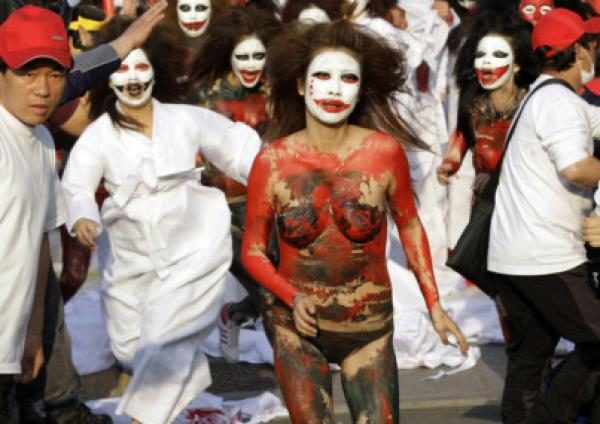
Korean sex wokrers protest against a law against trafficking and sexual exploitation that has taken away the incomes and dignity of these women – not a law against prostitution.
News story in the Globe News, 17 May 2011.
SEOUL, South Korea (AP) – Hundreds of prostitutes and pimps rallied Tuesday near a red-light district in Seoul to protest a police crackdown on brothels, with some unsuccessfully attempting to set themselves on fire.
- The International Association for the Study of Sexuality, Culture and Society 2011 Conference: A summary of the content related to sex work – 2011
- The Invisible Men: finding and engaging with the male partners of street sex workers – 2011
An article in press for the Journal of Men’s Health.
Men, in general, remain less likely than women to seek medical care, and are only half as likely as women to undertake preventive health visits and/or screening tests. There is a great need to increase men’s health awareness and reduce this significant gender disparity.
- TurboConsumers™ in paradise: Tourism, civil rights, and Brazil’s gay sex industry – 2011
Article in American Ethnologist, Volume 38, Issue 4, pages 666–682, November 2011.
- What Do Transgender Women’s Experiences Tell Us about Law? Towards an Understanding of Law as Legal Complex – 2011
Based on ethnographic study conducted in Istanbul, this thesis investigates the effects of law and legal operations on transgender women’s sex work and daily lives, and seeks to disentangle the multidimensional ways through which they and their conduct are governmentalized by law in Turkey. The first part of the thesis discusses the legal dynamics surrounding transgender sex work and delineates how transgender women are expulsed from regulated sex work by the interaction of the socially produced desire around their bodies and law.
- When Event Spaces and Commercialised Sex Spaces Overlap: Gendered discourses of sex work and the Olympic Games – 2011
In the past decade, debates regarding the sex industry, especially street-level sex work, have become exacerbated by the hosting of global sporting events. Such issues as displacement, safety concerns and financial cuts to social services have contributed to the problematisation of the overlap between mega event spaces and commercial sex spaces.
- ‘Knows how to please a man’: studying customers to understand service work – 2011
We can then see what demands a customer places on workers, understand where ‘his’ expectations come from and how ‘his’ judgements of good and bad service are produced in order to make
